
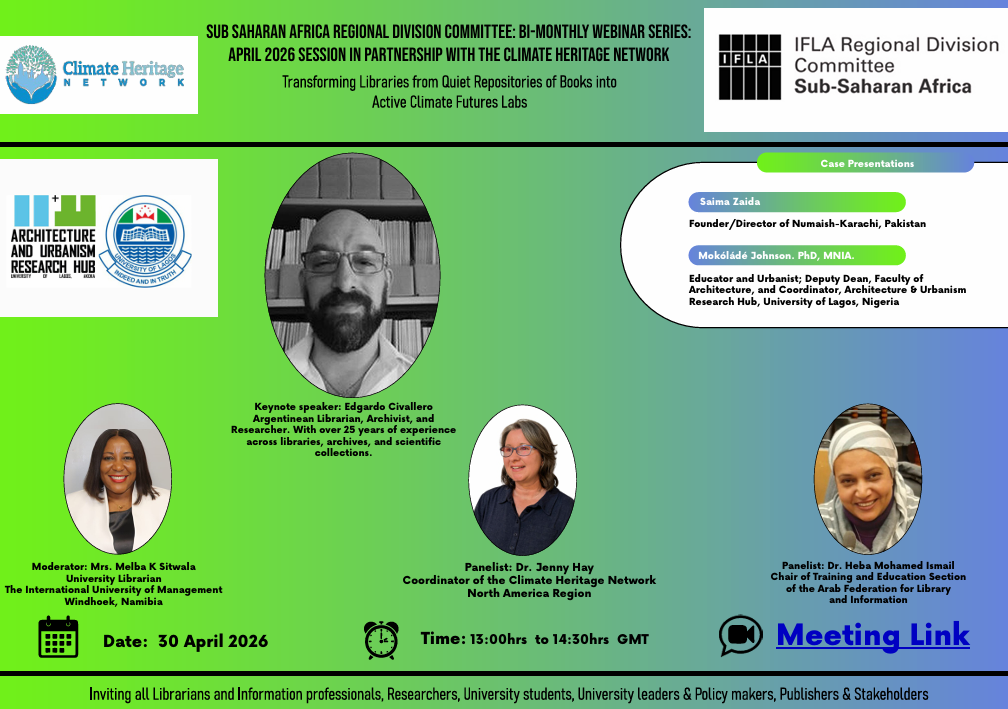
Webinar: Transforming Libraries from Quiet Repositories of Books into Active Climate Futures Labs
30 April 2026 13:00 GMT
Background
Libraries have traditionally been viewed as quiet repositories of books and information. However, they are also important cultural institutions that safeguard collective memory, preserve heritage, and support the transmission of knowledge across generations. In the face of the growing climate crisis, libraries are increasingly recognized as trusted community spaces where scientific knowledge, cultural heritage, and local experiences can come together to help people better understand climate change and imagine sustainable futures.
The Climate Heritage Network (CHN) and the International Federation of Library Associations and Institutions (IFLA) – Sub-Saharan Africa Regional Division share a common interest in strengthening the role of cultural and knowledge institutions in addressing global challenges. Through this collaboration, CHN & IFLA seek to highlight how libraries can evolve into dynamic “Climate Futures Labs”, spaces where culture, heritage, and knowledge converge to foster climate literacy, community dialogue, and locally grounded solutions for climate resilience.
Purpose of the Webinar
Explore how libraries can move beyond their traditional role as information repositories to become active spaces for climate learning, experimentation, and community engagement.
Objectives
To examine the emerging role of libraries in promoting climate awareness and environmental education.
To highlight examples of libraries functioning as spaces for climate dialogue, innovation, and community-based learning.
To encourage collaboration between the library sector and climate and cultural heritage communities.
To inspire libraries to adopt new approaches that position them as hubs for climate engagement and knowledge exchange.
Theme
Climate Information Access and Literacy
The webinar will run for approximately 90 minutes and will include the following sessions:
|
Session |
Speaker |
Time Allocation |
|
Moderator |
Mrs. Melba Sitwala (University of Namibia) |
Throughout the session |
|
Keynote Presentation |
Edgardo Civallero – Researcher, semantic architect, and biblio-naturalist with over 25 years of experience; former Library & Archive Director – Smithsonian Tropical Research Institute |
20 minutes |
|
Scene setting/ Case Presentation |
Dr. Mokolade Johnson – Library Transformations at the University of Lagos-Nigeria |
10 minutes |
|
Panel Discussion |
· Jenny Hay (PhD)– CHN North America Coordinator · Dr. Heba Mohamed Ismail – Former Vice President, Arab Federation for Libraries and Information (AFLI); Director of the 2030 Arab Librarians Program; Libraries Technical Manager |
15 minutes each |
|
Interactive Q&A Session |
All Speakers and Participants |
20 minutes |
Target Audience
Librarians and library associations
Cultural heritage professionals
Climate change practitioners and researchers
Policy makers and development partners
Students and young professionals
Expected Outcomes
Increased awareness of the role libraries can play in advancing climate literacy and community resilience.
Strengthened collaboration between library networks and climate action organizations/initiatives.
Practical ideas and inspiration for libraries seeking to engage communities on climate issues.
Adoption of innovative programs, services, and policies by libraries to support climate engagement.